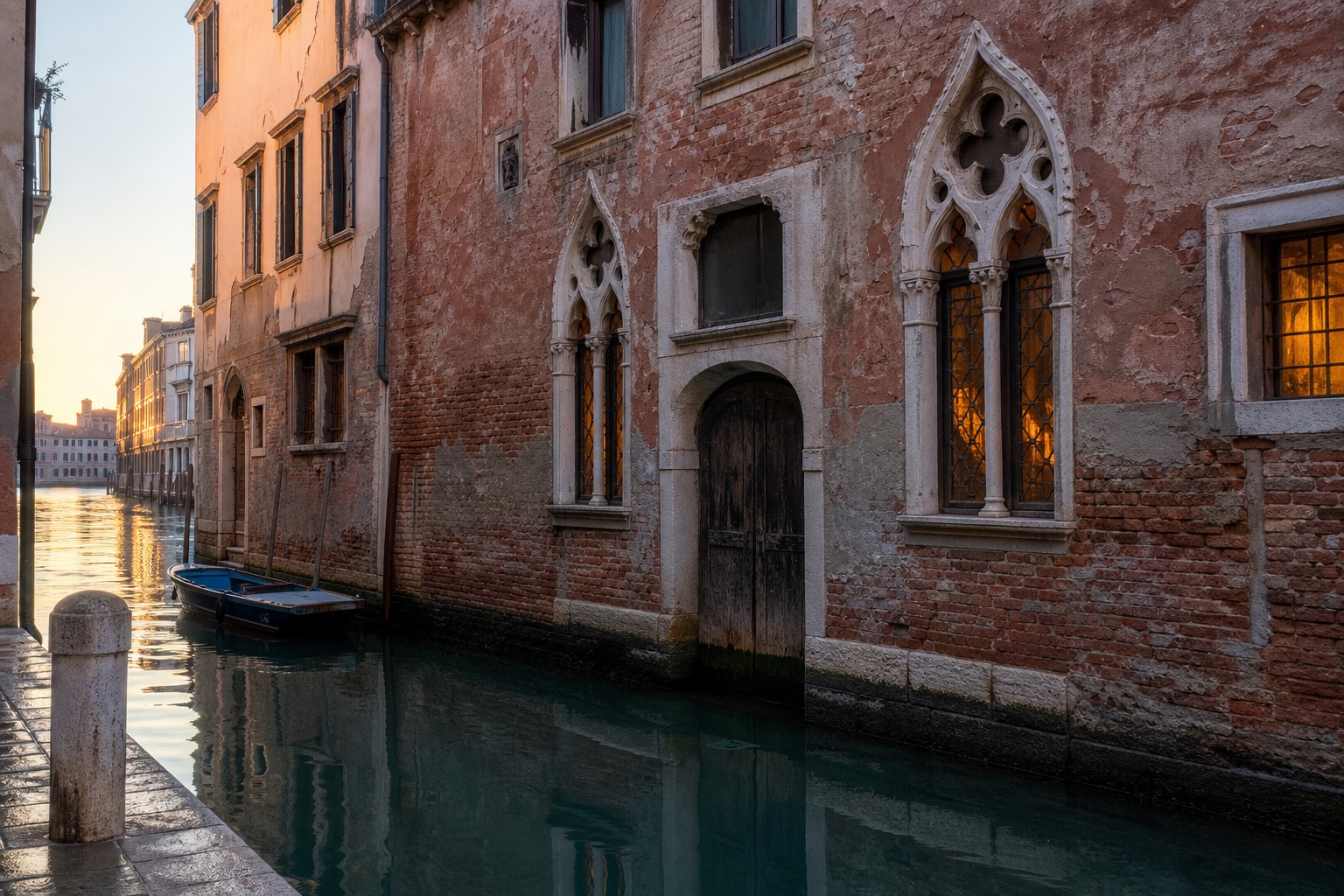
Agent · title · building · water · contract
Venice property due diligence, before the deposit.
Due diligence means checking the agent, records, building, contract, and payment instructions before you commit. Trust alone is not enough.
The basic rule
No single professional checks every part of a purchase.
The listing agent, buyer's coordinator, notary, technician, lawyer, tax adviser, lender, insurance professional, and condominium administrator have different jobs and interests. Put each person's job in writing and send every important question to the professional responsible for answering it.
A polished brand, years on a property portal, association membership, referrals, testimonials, or fluent English may help communication. None proves current legal authority, insurance, independence, skill for a particular issue, or the accuracy of a property claim.
Check the agent
Check the exact person and company—not only the agency name.
The Venice-Rovigo Chamber of Commerce tells consumers to use the Registro Imprese record to check a real-estate mediator. The Chamber does not issue a personal card that can replace this record. Under Italian mediation law, working without authorization can lead to penalties and may affect the right to a commission.
- Obtain a current company extract
Use the official Registro Imprese channel. Match the legal name, VAT number, REA, PEC, address, status, active mediation work, and the office presenting the property.
- Match the individual
Confirm that the person handling the mediation appears in an authorized role, such as owner, legal representative, or designated manager (preposto). Do not rely on a colleague's or franchise's credentials.
- Check professional liability coverage
Ask for the insurer, policy dates, insured company and people, covered work, limits, exclusions, and proof that the policy is current. Ask the insurer or an authorized professional to explain anything unclear.
- Read the agreement and commission terms
Identify whom the mediator represents, whether the agreement is exclusive, their authority, conflicts, referral or related-party relationships, fee and VAT, when payment is due, how the deposit is handled, cancellation terms, and what happens if property checks or financing fail.
- Get property claims in writing
Ask for documents—not assurances—about area, legal use, occupancy, planning and cadastral compliance, permissions, water history, shared costs, approved work, liens, rental status, and items included in the sale.
Venice-Rovigo Chamber guidance for checking an agent · Law 39/1989.
Build the buyer's team
Give the legal, technical, commercial, and personal questions to the right people.
| Role | What they usually handle | Do not assume |
|---|---|---|
| Buyer's chosen notary | Identity, authority to buy or sell, title, registrations, deed, legal formalities, and tax collection | A physical survey, renovation design, cost estimate, or representation in price negotiations |
| Independent geometra / architect / engineer | Planning and cadastral records, physical condition, systems, elevation, water, permissions, and proposed work | Title opinion, tax advice, legal representation, or every specialist test unless it is included in the written list of checks |
| Mediator | Bringing parties together, sharing listing information, and communicating during negotiations | Independent legal or technical confirmation, an appraisal, or a duty to put only the buyer first unless this is legally documented |
| Lawyer | Contract drafting, how risks are assigned, disputes, ownership, inheritance, and other legal issues | Notarial, technical, tax, or immigration work that is not included in the written agreement |
| U.S. and Italian tax advisers | Residence, ownership, income, reporting, inheritance, company, and funding consequences | That advice in one country resolves obligations in the other |
| Authorized insurance intermediary | Coverage for the exact property, exclusions, limits, deductibles, required disclosures, and claims | That a condominium or standard fire policy covers acqua alta or an empty home |
The property documents
Match ownership, legal records, present condition, and future costs.
Seller and title
Identity, legal authority, ownership history, inheritance, marital or company authority, co-owners, rights of use such as usufruct, occupancy, leases, rights of first refusal, easements, mortgages, liens, seizures, restrictions, and how any claims will be removed before closing.
Planning and cadastral records
Original and later permits, lawful use, cadastral plan and data, actual layout, penalties or steps taken to legalize work, habitability or agibilità records, protected status, landscape and heritage approvals, and pending applications.
Condominium
Declaration and rules, ownership shares, accounts, unpaid amounts, budgets, meeting minutes, lawsuits, contracts, staff, insurance, reserves, approved work, energy systems, short-rental restrictions, and which costs belong to the seller or buyer.
Building condition and systems
Structure, roof, façade, canal edge, foundations, moisture and salts, timber, windows, drains, electrical, gas, heating and cooling, plumbing, fire safety, elevator, energy certificate, pests, asbestos, and other materials where relevant.
Use and handover
Whether the home will be empty at closing, occupants, leases, licenses, furnishings, storage, water gate, roof or courtyard rights, keys, meters, utilities, service contracts, and handover condition.
Costs
Tax estimates, notary and professional fees, commission and VAT, financing and currency exchange, immediate repairs, major shared building work, insurance, utilities, IMU/TARI, maintenance, access, and money set aside for surprises.
Ask the independent technician to provide a written list of checks and anything excluded for this property. A “clean” cadastral plan alone does not prove compliance with planning rules or show the home's physical condition.
Venice-specific checks
Add elevation, salt, access, and protected-building records.
- Measured elevationMeasure the finished floor, entrance, courtyard, storage, meters, water gate, shared routes, door thresholds, and system equipment against the local tide reference.
- Water and damp historyAsk about past tide or rain entry, salt or rising damp, mold, repairs, pumps, barriers, drains, non-return valves, insurance claims, photographs, invoices, and written statements from the seller or administrator.
- Canal edge and shared partsCheck foundations and any settlement, the canal wall or water gate, wave exposure, roof and façade, engineer reports, nearby public work, who is responsible, approvals, and planned restoration.
- Heritage and landscape rulesCheck restrictions and approvals for windows, shutters, roof, façade, outdoor equipment, heating and cooling, other systems, layout, waterproofing, barriers, signs, and earlier alterations.
- Construction accessAllow for boat and porter access, bridge count, scaffolding, permits, work hours, debris and waste, contractor storage, condominium rules, effects on neighbors, and extra time and cost.
- InsuranceGet written terms for the exact property, floor, use, periods when it will be empty, condition, past events, water damage, interaction with the shared policy, deductibles, limits, and required protections before you commit.
See the separate Venice climate and acqua alta guide, the City's landscape authorization page, and UNESCO's Venice and its Lagoon record.
Contract and payment safety
A short purchase proposal can carry long consequences.
An accepted proposal can become binding, and a preliminary contract commits both parties to complete the sale. Before signing, get advice on the exact document. It should address the buyer's identity and authority, the exact property and rights, legal and physical status, price and payment, deposit type, financing, inspection and correction conditions, occupancy, included items, approvals, closing, commission, default, remedies, language, which version controls, and who holds the money.
- Never wire money to an unconfirmed personal or changed account because an email says the deadline moved.
- Confirm the recipient's legal name, IBAN, bank, reason for payment, authority, and amount through a trusted phone number or other channel you found independently.
- Know whether the money is a deposit, advance, amount held by a third party, notarial deposit, commission, tax, or fee, and read the written release and refund rules.
- Keep the instruction, record of how you checked it, receipt, bank confirmation, currency record, and contract clause.
The Notariat recommends involving the notary early. It also explains that registering a notarial preliminary contract can protect the buyer against certain later claims recorded against the property, depending on the case.
Tourist-rental rules
A listing's income estimate does not prove the right to rent.
Venice has its own tourist-rental rules on top of regional and national requirements. National CIN rules apply to covered accommodations and advertisements. Venice's current experimental rules add requirements for some tourist rentals offered for more than 120 days per year. Current rules and any transition arrangements need to be checked for the exact property.
Before counting rental income, confirm lawful use, current registrations and notices, CIN, regional and municipal identifiers, condominium restrictions, safety and equipment duties, guest reporting, taxes, management arrangements, records of past occupancy, penalties, and whether the seller's existing status transfers to the buyer. Use cautious estimates for occupancy, fees, maintenance, utilities, tax, insurance, compliance, closures, and management—not an agent's headline nightly-rate projection.
Comune di Venezia tourist-rental FAQs · Tourism Ministry CIN FAQs.
Frequently asked questions
What to check before you rely on anyone's advice.
How can an American verify a Venice real-estate agent?
Obtain a current Registro Imprese extract and match the exact mediator, authorized role, active business status, VAT/REA/PEC details, professional liability coverage, fees, written agreement, and conflicts.
Does the notary inspect the home's physical condition?
Not as a substitute for a technical inspection. The notary handles the legal work. An independent technician should check planning and cadastral records, structure, systems, moisture, water, and physical condition based on a written list of checks.
Should a buyer pay a deposit before the checks are complete?
A proposal or preliminary contract can be binding, and the consequences of a deposit depend on the wording. Have the exact document reviewed and add appropriate conditions before signing or moving money.
Do short-term rental rights transfer automatically?
Do not assume so. Check the exact unit's municipal, regional, national CIN, condominium, safety, registration, prior status, and transfer position before assigning value to rental use.
Sources and limits
Official places to start.
- 01Venice-Rovigo Chamber of Commerce
- 02Normattiva
- 03Italian Notariat
- 04Comune di Venezia
Sources reviewed July 17, 2026. Registers, policies, laws, city requirements, property condition, and documents can change.
This checklist is general education, not a title opinion, technical report, appraisal, legal, tax, brokerage, notarial, engineering, surveying, insurance, investment, or rental-compliance conclusion. It cannot identify every issue. Hire independent qualified professionals and give each one a clear written job for the exact buyer and property.