Location strategy · U.S. buyer guide
Milan city center or outside the city?
The better address is the one that makes your ordinary week work. Compare central Milan, outer-city districts, and surrounding municipalities before a beautiful listing turns into an inconvenient home.
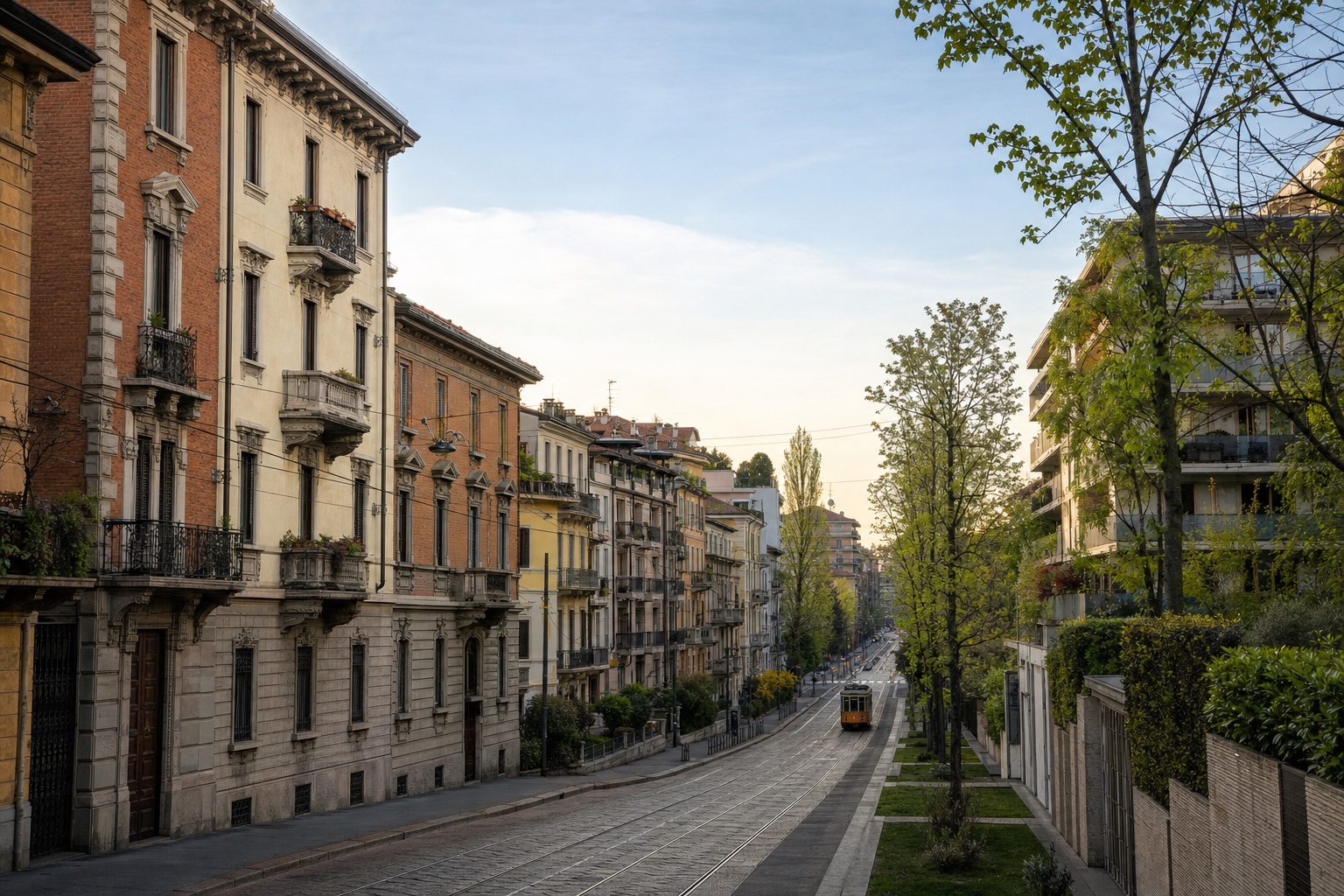
There is no single “best” place to live in Milan. Central addresses often exchange space and quiet for immediacy; outer-city homes can preserve Milan services with more residential texture; surrounding municipalities may offer more room but add another layer of commuting and local administration.
A useful starting rule
Choose from the fixed parts of your life—school gate, office days, airport pattern, care needs, evening habits—not from a generic neighborhood list. Then compare actual buildings and blocks within that smaller search area.
For a U.S. buyer, the distinction also matters because crossing a municipal boundary can change public-school enrollment, local procedures, transport assumptions, and property-tax administration. Confirm the exact Comune and civic address; do not treat a listing’s broad “Milan” label as a legal location.
First, define the geography
“Center” and “outside” describe three different searches.
Historic and inner Milan
Dense, established neighborhoods with a high share of older buildings, strong access to culture and services, and a premium on quiet, light, elevators, outdoor space, and parking.
Outer Milan, inside the Comune
Residential districts within the City of Milan. The value proposition can shift block by block according to metro access, rail lines, new development, services, and building quality.
Surrounding municipalities
Separate comuni in the metropolitan area. More space or a different housing type may be possible, but school enrollment, local taxes, services, and the last mile of every commute need separate verification.
Price comparisons should use the same property type and period, not citywide averages applied to a single apartment. See the clear calculation notes in the NOTICE Milan property price index and consult the City of Milan’s open OMI quotation dataset, which publishes zone-level reference ranges rather than appraisals or completed-sale prices.
Side-by-side
Compare the operating life of the home.
| Decision factor | Inner Milan | Outer Milan | Surrounding Comune |
|---|---|---|---|
| Daily access | More destinations may be reachable on foot or by short transit trips. | Often depends on the exact metro, tram, bus, or rail connection. | Regional rail, driving, and the last mile can determine whether a location works in daily life. |
| Space and building type | Space, elevator access, terraces, and parking can be scarce within a buyer’s range. | A broader mix of older apartments, postwar buildings, and newer developments. | Potential for larger homes or different property types; supply varies by municipality. |
| Noise and privacy | Street, restaurant, delivery, and courtyard activity require address-specific checks. | Can feel more residential, but ring roads and rail infrastructure matter. | Potentially quieter; road, flight, rail, and development noise still require testing. |
| Schools | Public-school planning is address-led and capacity-dependent. Independent schools can make a suburban campus commute more important than centrality. | ||
| Car dependency | A car can be optional for many routines; parking and access rules need review. | Varies sharply by transit connection and household routine. | A second transport plan may be needed when rail or school transport is unavailable. |
| Future resale | Never assume a home will be easy to resell because of location alone. Building condition, floor, light, layout, legal compliance, fees, and asking price all affect buyer interest. | ||
The real differences
What each location can give—and ask of you.
Buying in central Milan
Potential benefits
- Shorter access to a dense mix of work, dining, retail, health care, and cultural destinations.
- A walk-and-transit routine may reduce dependence on a car.
- Historic architecture and an established city neighborhood may match the reason for moving to Milan.
Potential drawbacks
- Buyers may compromise on area, light, lift access, parking, outdoor space, or renovation condition.
- Older condominium systems can make cooling, windows, services, and major works more complex.
- Noise and delivery activity are highly strongly on the address and which direction the home faces.
Buying farther out
Potential benefits
- A buyer may find more space, storage, newer systems, gardens, or easier parking at the same budget.
- Some outer districts and municipalities provide a slower residential rhythm and more green space.
- A location near a school campus, regional rail station, or airport route can outperform a central address for a particular household.
Potential drawbacks
- A short distance on a map can become a long door-to-door trip after transfers and the last mile.
- Fewer spontaneous alternatives may make service interruptions or evening returns more consequential.
- A separate Comune means separate local systems; do not assume City of Milan enrollment or services.
For families, test the school route before the neighborhood
City public-primary planning is linked to the child’s home address, while independent schools may sit outside central Milan. The City’s address-based school lookup and current enrollment instructions should be checked before relying on a catchment assumption. Our Milan schools guide for American families explains the routes.
A better viewing checklist
Model Tuesday, not vacation Saturday.
Build a door-to-door timetable for the routines that cannot move. Run it at the times you will actually travel, with a realistic walk, transfer, parking, and pickup buffer.
- Anchor the week.Mark school arrival and pickup, office days, health appointments, caregivers, airport trips, exercise, and evening commitments.
- Test both directions.Ride or drive the route in the morning and evening. Include the final walk and a weather-day alternative.
- Audit ordinary errands.Locate groceries, pharmacy, pediatric or primary care, parcel handling, pet needs, waste points, and late-evening transport.
- Count the full daily cost.Compare not only purchase price but condominium charges, parking, car ownership, school transport, taxis, and the time cost of transfers.
- Keep a second route.Ask how the week works during a transit interruption, severe heat, heavy rain, or a missed connection.
Checks for the exact address
Citywide reputation cannot answer building questions.
Inside the building
Check how light changes with the direction the home faces and the season, plus lift access, steps, window performance, heating and cooling, common-area condition, storage, bike access, parking rights, concierge hours, approved works, and condominium rules.
At the block
Return at commute time and late evening. Listen with windows open and closed. Trace the actual transit walk, note lighting and crossings, and check loading, restaurants, construction, schools, venues, rail, and road exposure.
Heat and water
Top floors, western exposure, limited shade, and restrictions on exterior equipment can change summer comfort. Ground floors, cellars, garages, and lowered entries need water-path checks. Use the City’s official hydraulic-risk materials as one input, not a property guarantee.
Legal boundaries
Have the buyer’s notary and appropriate technical professional verify title, cadastral and planning compliance, easements, occupancy, condominium records, and the exact rights included. Choosing an area does not replace legal and technical property checks.
The City of Milan reports an urban heat-island effect of roughly 2°C relative to rural surroundings, which makes trees, the direction a home faces, shading, ventilation, and cooling capacity property-level questions. Read the City’s urban cooling overview and our climate guide for homebuyers.
Primary sources
Sources used in this guide
- Comune di Milano — OMI property quotation datasetZone-level, semiannual reference ranges; not transaction prices or appraisals.
- Comune di Milano — primary and secondary school enrollmentCurrent municipal process, preferences, and capacity context.
- Comune di Milano — urban heat and coolingCity context for heat-island exposure.
- Comune di Milano — detailed hydraulic analysisOfficial planning documents for flood-hazard checks.
Sources were last checked July 17, 2026. Rules, transport, school capacity, market conditions, and property facts change; verify current details with the responsible authority and independently engaged professionals.
A search plan built around your life
Turn location choices into a focused Milan search.
NOTICE Milan coordinates the practical buyer process and brings independent licensed professionals into the work where their advice is required.
Discuss your Milan purchase